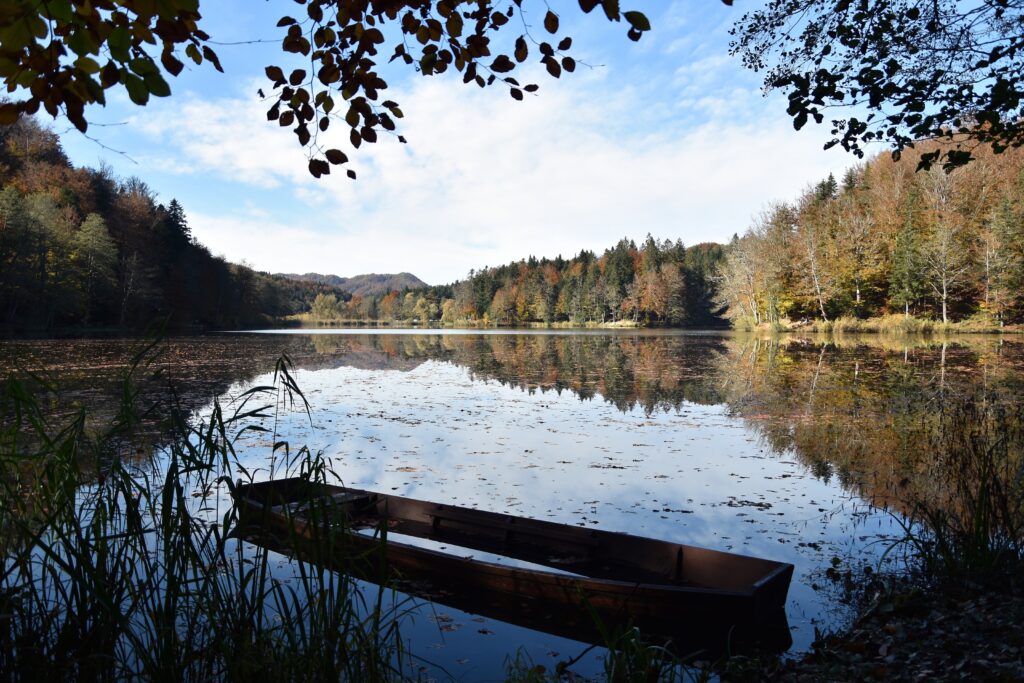
Autumn.
To some, a favourite season of the year.
I have always preferred spring and summer above autumn; sunshine, warmth, and bloom above rainy days and early nights.
But that autumn day was more perfect than any summer or spring day could have been. It was one of rare October weekends full of sunshine, with no grey clouds in sight. We decided to visit Trakošćan castle and the surrounding park, which has been protected as a forest park since 1955. There are 27 forest parks in Croatia, all of them with a significant landscape value. Only those activities whose purpose is its maintenance may be performed within the park forest.
Even the drive there was magical. Maybe spring and summer are my favourite seasons, but they cannot paint the landscape in such an incredibly vivid and warm palette. Around every next corner, the woods became more colourful and the scene became more pleasant for the eyes.
The park forest itself seemed to be well managed and, considering a large number of visitors, I was relieved when I noticed no litter around during our walk.
In the heart of it all lies the Trakošćan lake, an artificial lake made in the 19th century for fishing and for aesthetic reasons. Around it goes an educational trail with instructional boards that contain topics about biological, ecological and geological features of the area. Every board has a distinct topic and makes one whole.
People sometimes find those boards unreadable, but these are made in a way that captures the attention of both children and adults. I was thrilled to see little children pointing at different animals painted on boards and parents reading their names and facts about them.
Education made fun and enjoyable is a great way of teaching. Although people often say it, they are rarely fully aware of it.
But being there that morning, it was clear. We had an exceptional day full of sun, of crisp air, of silence, full of calmness. We built a connection with nature. Far from our hometowns, concrete and our offices.
With that bond slowly revealing and getting stronger, we start caring more. And with caring, we begin to act differently.
If you care for the woods where you hike every weekend because it makes you feel strong and alive, litter that you stumble upon may start bothering you, and maybe one day you will pick it up.
If you care for a certain species or a group of animals because you have revealed and understood their peculiarities, or you find them intriguing for a certain reason, doing them harm out of ignorance may start bothering you, and maybe one day you will start researching and protecting them, or educating other people about their value.
But the first step to changing our acts in favour of nature is connection – whether it is with a certain species of animal, fungi or plant, or the whole ecosystem. There has to be a core bond between us and the world, where we find our motivation and our reason to guard it.
Literature
https://narodne-novine.nn.hr/clanci/sluzbeni/1994_04_30_521.html