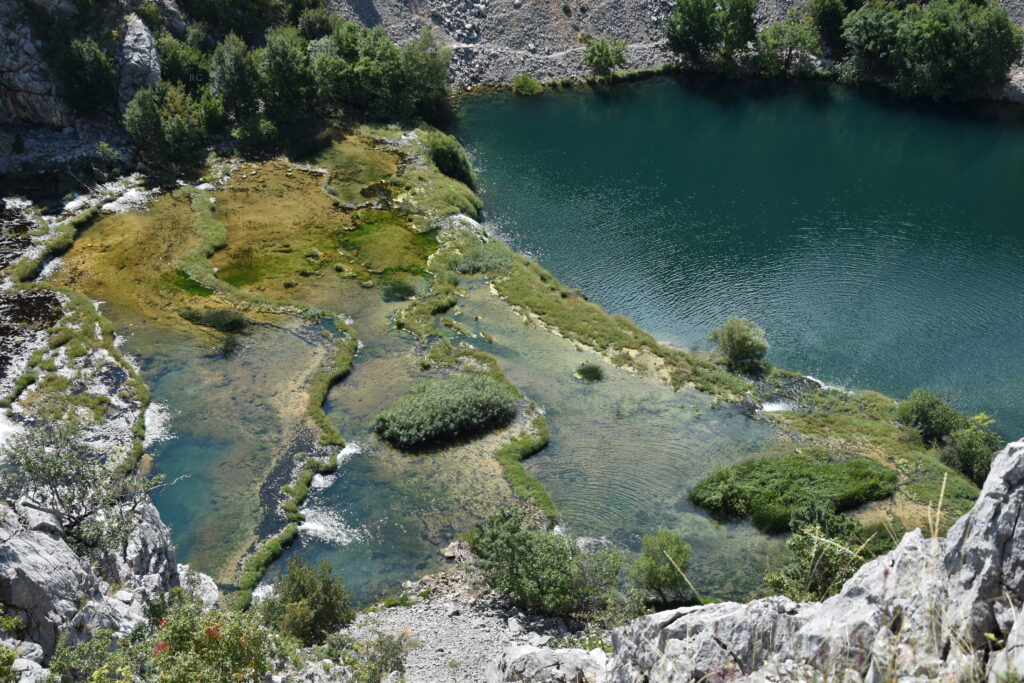
Many of us have heard of tufa barriers on the Plitvice Lakes or Krka River, but they are certainly not the only example of that phenomenon in Croatia.
The Cascades of the Krupa River, right below the Velebit mountain, also exist thanks to the combination of freshwater organisms and specific physical and chemical factors.
First of all, water has to be rich with dissolved calcium bicarbonate. Second, alkaline pH value and low concentration of organic matter are required. The water flow must be fast to disturb the chemical balance of the water, which leads to the release of carbon dioxide in the air.
Also, bacteria, algae and mosses in the water help in “catching” calcite. When calcium bicarbonate “loses” its carbon dioxide part, calcium carbonate (CaCO3) precipitates, and microcrystals of calcite attach to the sticky surface of cyanobacteria and certain algae species.
Calcite layer produced in this way continues to develop as far as all needed conditions are maintained, which leads to a slow, but a persistent change of waterfalls and cascades.
The cascades on the Krupa River form the longest tufa barrier on that river and end with a 10 meters tall waterfall.
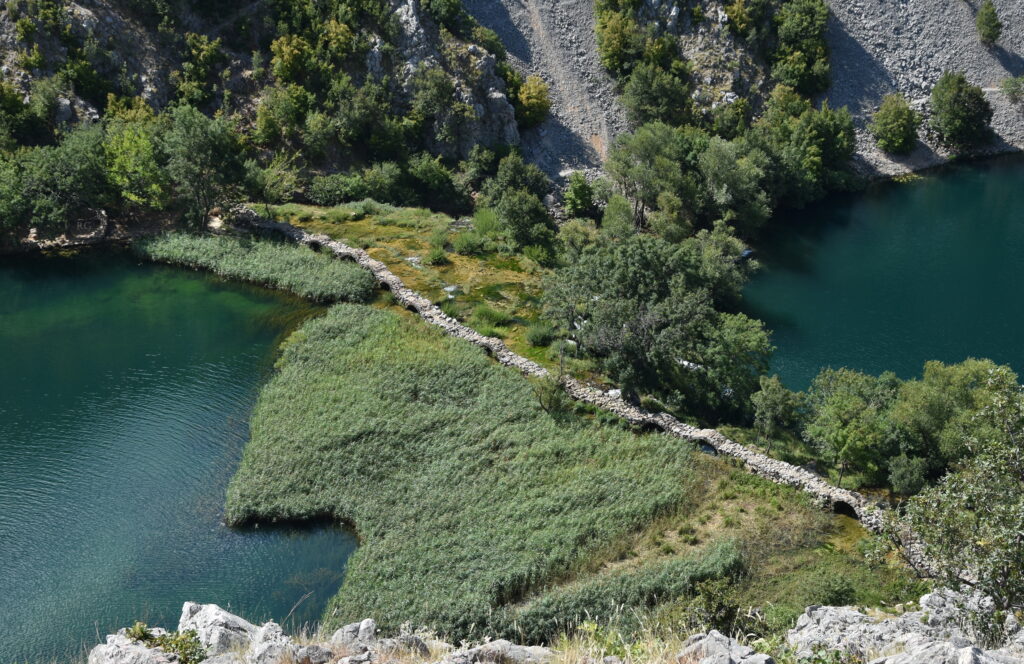
It would be very difficult to cross from one shore to the other, but there stands a unique structure right above the waterfall – Kuda’s Bridge, the oldest preserved crossing of the Krupa River. It was built at the turn of the 19th century in the dry stone wall technique, without any binding materials.
As there are stories about almost every intriguing building from the past, this bridge has its own, too.
The legend speaks of a young man from a nearby village who fell in love with a lady from the other side of the river. He built a bridge with twelve arches made from tufa blocks and twelve stone pillars, all with his bare hands, to cross the river and propose to her.
Seeing this place on the photographs was one thing, but being here was a completely new experience.
To approach the river, one must climb down for almost 300 metres across the arid rocky land. At the very beginning of that path, in an old cottage, there lives an old man, guarding his goats and selling cheese and honey.
At the first moment, the scene seemed pastoral, but after only a few words exchanged, I could feel how lonely he was. He lived there by himself, his wife had passed away, and his only company were his goats and constant passengers – but the former cannot speak to him, and the latter would leave as they came, quickly and suddenly.
Discovering another after another piece of the river from the above, I was in awe how even more magical the river seemed, covered in rich greenery, opposed to the dry rocky slopes around it – as if it was hidden there in the foothill from all unwanted looks.
There is something secret in this sort of place. Being down there, seeing hidden nature in its true state, being surrounded by picturesque cascades covered in green and an immense strength of free-flowing water.
The only trace of human existence is the old bridge, but it seems that it has united with the surrounding nature during the centuries. It is nice to remember the old ways of using materials, old ways of building.
This bridge stands as a monument to a man’s dedication, love and commitment, that can serve as an example to all of us. But also, it stands as a monument to the old way of doing things, tradition, and patience.
New times bring many good changes. By accepting those changes, we evolve, reach limits, and then move them and set new ones.
But we often forget that not everything new is good, not everything new is better than old.
Maybe today’s way of crossing the obstacles is a lot better than before, but we have lost our fathers’ patience.
Maybe today’s way of building is a lot better than before, but we have lost our fathers’ dedication.
Maybe today’s innovations are incredibly advanced, but many of us have forgotten their tradition.
In our constant thinking about faster and faster development, we often completely forget about the consequences of our innovations for our own well-being and well-being of nature.
So, there stands this unique, old stone bridge to remind its visitors that we can be patient, dedicated, passionate, that once we become determined, all the power is in our hands, and that despite our actions, our environment does not have to suffer, but can keep flourishing.
Literature
Pingback: Plitvice Lakes - Ritosaurus