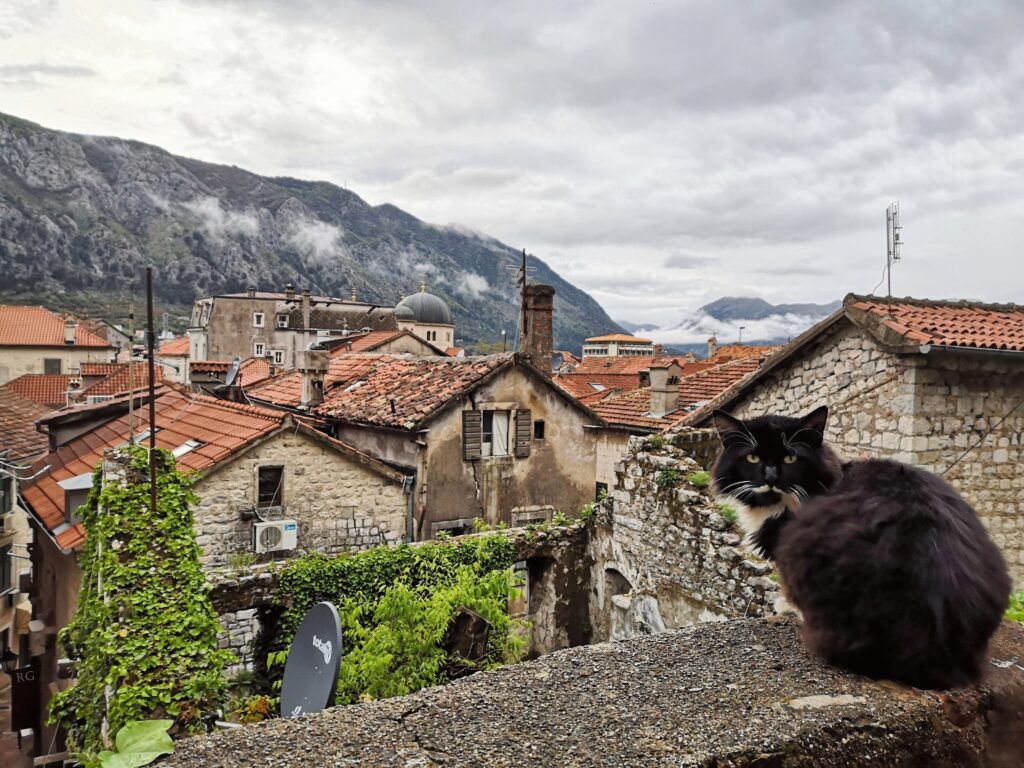
It doesn’t take much time to notice how big the feline population is there in Kotor – those cats are homeless, but they definitely don’t look hungry or untidy. Citizens of Kotor and tourists seem to be fond of cats, giving them food and water, petting them, and even making them a symbol of Kotor.
For centuries, the town of Kotor, Montenegro, was a trading port, and cats came with the ships from all around the world.
With that many stray cats in town, it is probably almost impossible for mice or rats to thrive, and if there are some, they have to be more clever than those not surrounded by hundreds of enemies.
Are those cats invasive species? No, because of three reasons.
As far as we know, cats in Kotor neither affect human health nor cause economic damage, and although we can assume they change the number of small mammals such as rats, there is no exact evidence of reducing biodiversity.
Furthermore, some non-native species adapt and fit in the new area so well that, after some time, they are not considered alien species anymore.
Alien species are species introduced by humans outside of their natural habitat.
We cannot know how a new species will interact with others and with the environment.
An introduced species can have different responses on different territories – it can be invasive in one area and not in another. A non-native plant can seem harmless while being cultivated but can cause trouble once it expands beyond flower pots or yards.
types of impact
There are three types of negative impact caused by invasive alien species (IAS):
- reducing biodiversity
- causing economic damage
- affecting human health
For example, maintenance of pipes clogged with zebra mussels (Dreissena polymorpha), costs the USA power industry up to $60 million per year, and comb jelly Mnemiopsis leidyi led to the collapse of the fishing industry on the coast of the Black and the Caspian Sea.
Once an established population of an invasive species is almost impossible to remove; in this case, the phrase “better safe than sorry” couldn’t be more accurate. Nowadays, due to the rise in transportation, commerce and travel, the spreading of species and the number of new invasive species are rapidly increasing.
how can we help?
These are some small steps which every one of us can do.
- Avoid planting non-native plants. If you already have a plant like that in your garden, provide control in order to avoid its spreading.
- Don’t release exotic pets, fish, plants or any other non-native species. Algae Caulerpa taxifolia and turtle Trachemys scripta are just two of many invasive species that came from the aquarium.
- Clean your equipment (backpack, boots) before and after every hiking to avoid transporting seeds, pests or pathogens.
- Report an invasive species if you notice it.
Useful links
There are some websites where you can check which species are invasive – and don’t forget that it depends not only on species but also on area, climate, other present species, and various abiotic factors if an alien species will become invasive.
Europe:
https://ec.europa.eu/environment/nature/invasivealien/list/index_en.htm
Croatia:
https://invazivnevrste.haop.hr/
Pingback: Ferns - Ritosaurus