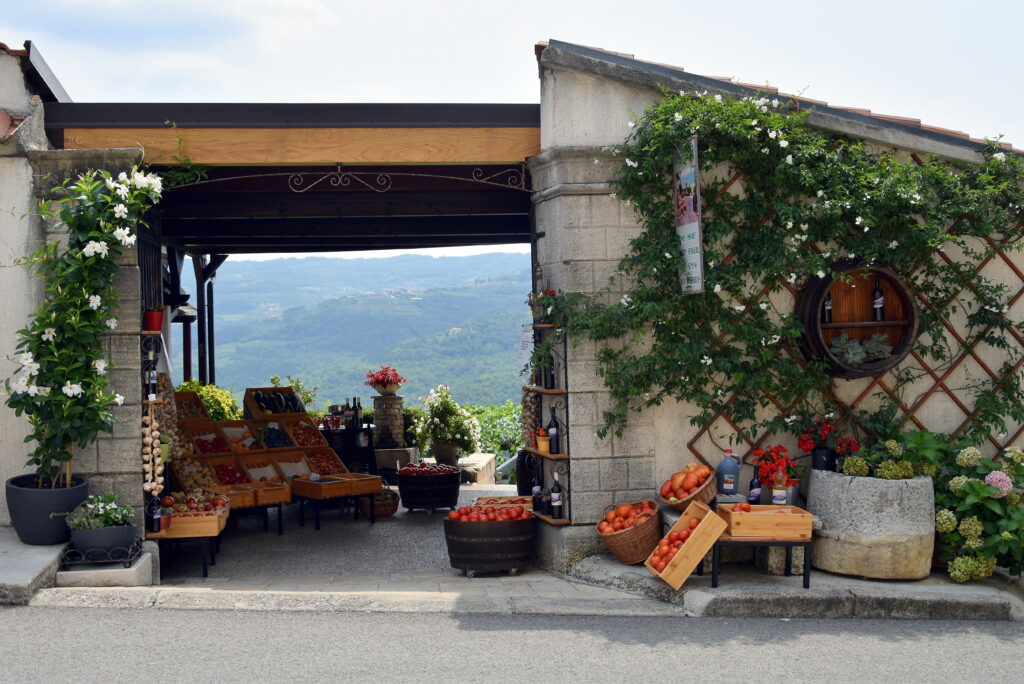
I just love morning walks on markets, especially when I stumble upon magical places, like the one in the photograph. I admire people who grow their food in a traditional way, investing their time and strength in it. It must be a fulfilling sensation to really see, taste, and enjoy the fruits of your work.
But today, huge shopping retail chains offer an incredible variety of products, usually for a lower price, at any time of the year. Walking through the aisles filled with all different kinds of fruits and vegetables, it is difficult not to ask myself how much of it goes to households, and how much goes to – waste.
food loss vs food waste
An estimated one-third of food produced globally is unused every year, equaling a total of 1.3 billion tonnes!
UN’s Food and Agriculture Organization (FAO) separates this global problem into two categories: food loss and food waste.
Food loss refers to any food that is discarded along the food supply chain before the retail level.
Food waste refers to the decrease in the quantity or quality of food resulting from decisions and actions by retailers, food service providers, and consumers.
Unless you don’t work as a retailer, you are probably unaware of the proportion of food wasted before anybody could even try to buy it.
Broken plastic bags of chips, damaged eggs, uneven packaging, distorted cardboards, damaged fruits and vegetables, food with expired dates – it all goes through the selection and is being discarded in the stores. Moreover, products don’t even have to be damaged to be discarded. In Europe, more than a third of farmed fruit and vegetables, crossing 50 million tonnes, is thrown away even before reaching the stores because they are the “wrong” size, or “unattractive” shape or colour.
Only after one part of food in markets is thrown away, customers can buy the rest of the food. Some of the products are discarded from shelves because their expiration date has passed, or they were damaged by retailers or customers. At last, after buying products, some of the food is discarded by customers because its “use by” date or “best before” date has passed. The other major category of food discarded by customers is leftovers.
“USE BY” VS “BEST BEFORE”
Speaking of expiration dates, there is a major difference between “use by” and “best before” dates.
The “use by” date is about safety, and it is usually written on food that cannot last long, for example, meat. We have to avoid consuming food after that date because it can be unsafe for our health.
On the other hand, the “best before” date is about quality and not safety. In other words, food is safe to be eaten after that date, but it can lose some of its initial quality in terms of flavour or texture.
In Europe, around 50% of food waste is estimated to come just from households.
FOOD WASTE & ITS ENVIRONMENTAL IMPACT
Food loss and food waste are indirectly connected to different environmental impacts: deforestation and soil erosion, water and air pollution, and greenhouse gas emissions that occur in the process of food production, transportation and waste management – it is all consequence of food production, but in terms of food loss and waste, it becomes needless and excessive.
According to recent studies, the energy content of food waste may be an environmentally more important parameter than the mass of wasted food. So, the wasted food itself may be less of a problem than all the energy and the resources invested in its production.
Around 173 kilograms of food are wasted per person in the EU every year. How many times have you thrown old bread because you bought more than you needed? How many times have you thrown pasta and rice because you cooked too much of it?
More water than we might think is required to produce food. In order to produce 1 kilogram of pasta, more than 1800 litres of water is needed, and 2500 litres for 1 kilogram of rice.
By throwing old bread, salads, potatoes, pasta, rice, and meat, we also throw away water. Already scarce and valuable water resources are invested in food that we often use irresponsibly.
Also, all the food that we throw away today had to be cultivated, watered or fed, stored properly, and transported. The gas spent on transport and road tolls had to be covered, and the salaries had to be paid. There are many invisible factors that we forget that lead to the food on our plates.
Stay tuned for the next post, where we will see how we can reduce food waste in our homes with just a few simple tips.
Literature
Hall K. D., Guo J., Dore M., Chow C. C. (2009): The Progressive Increase of Food Waste in America and Its Environmental Impact. PLoS ONE 4(11): 7940
Schanes K., Dobernig K., Gözet B. (2018): Food waste matters – A systematic review of household food waste practices and their policy implications. Journal of Cleaner Production 182: 978-991
Von Massow M., Parizeau K., Gallant M., Wickson M., Haines J., Ma D. W. L., Wallace A., Carroll N., Duncan A. M. (2019): Valuing the Multiple Impacts of Household Food Waste. Frontiers in Nutrition 6: 143
http://www.fao.org/food-loss-and-food-waste/en/
Pingback: Food waste - part 2 - Ritosaurus