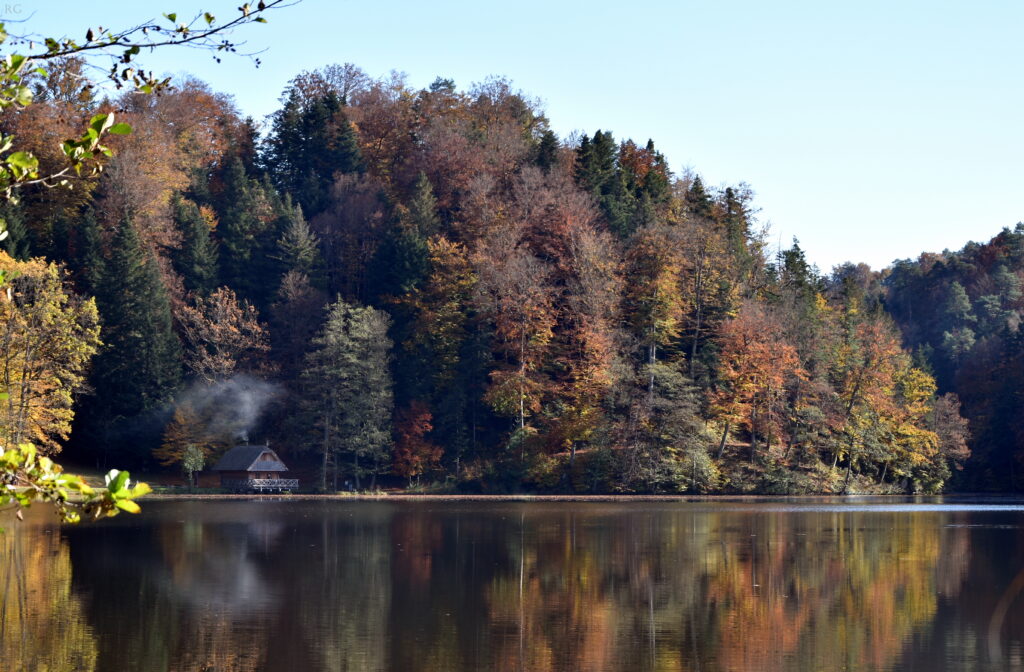
Cozy, wooden little house in the middle of an old forest – imagine hot tea or coffee, soft blankets, a perfect lake view through the window, and fire crackling and sparking in the woodstove.
It can hardly get more idyllic.
The use of wood for heat is widely spread because it is a relatively cheap and quite efficient way of heating indoor space.
Some people also favor wood as a source of heat because they see it as an eco-friendlier source than fossil fuels.
Here comes the question of whether forest biomass is carbon neutral or not – first of all, let’s explain carbon neutrality. It is a balance between emitting carbon and absorbing carbon from the atmosphere. The main natural carbon sinks (systems that absorb more carbon than they emit) are soil, forests, and oceans. Those natural sinks help in removing carbon (carbon dioxide, CO2) from the atmosphere, thus helping against climate change.
So, is forest biomass carbon neutral? Trees absorb carbon dioxide from the atmosphere. If we burn a tree in our woodstove, we can easily plant another tree that will absorb carbon instead of the previous one, and we can think that, on a microscale, we achieved carbon neutrality.
But, it is not that simple, of course. Not only cutting trees decreases the forest areas that absorb carbon but on top of that, burning wood releases carbon dioxide immediately; on the contrary, a significant amount of time is needed – decades or centuries – for the newly planted tree to grow and absorb the released amount of carbon.
In other words, we cut forests that would absorb carbon, and then we burn wood that produces more carbon.
Forest biomass could be seen as carbon neutral perhaps only if observed long-term.
But, according to the Cary Institute of Ecosystem Studies (2018), even if a new tree is planted for every burnt tree, it would take 40 to 100 years for a managed forest to capture the same amount of carbon as a natural forest. Since most plantation forests are harvested at shorter intervals, they may never make it to the carbon-neutral point.
It seems that wood burning is not climate neutral after all – at least not in the short term, and it would require an increase in forested area and improvement in forest management to be climate neutral in the long term.
What is the best source of heat, the best option for our climate? Maybe we do not know it yet, but that does not mean there is no optimal solution. We just have to find it.
Literature
Cary Institute of Ecosystem Studies. “Wood pellets: Renewable, but not carbon neutral: Turning forests into fuel comes at an environmental cost.” ScienceDaily. ScienceDaily, 22 March 2018.
https://www.smithsonianmag.com/smart-news/epa-declares-burning-wood-carbon-neutral-180968880/