Warmer days are coming.
The meadow was full of this spring’s first snowdrops and primroses, proudly shining on a soil that was frozen only several days ago.
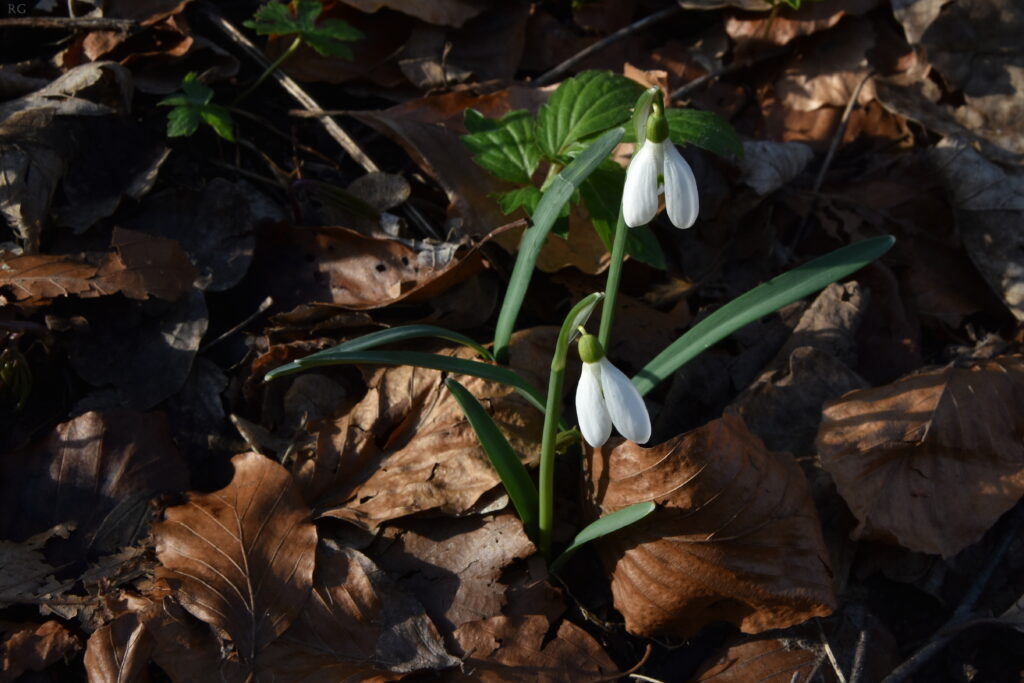
I could not stop searching for a perfect flower in perfect light to take a picture. And then I found them – two newly sprouted snowdrops that found their way through the autumn’s fallen leaves, only slightly illuminated.
When I came home, I went through and revised the photographs on a big screen, and then I saw this one.
Yes, these snowdrops were still the main motive, but they were not the reason why this photograph attracted my attention. The point of this photograph suddenly became this ordinary fallen leaf on the left. The forest floor was full of dry leaves, and this leaf was just another one among them.
But unlike others, its colour was deeply, chocolate-like brown, and its texture seemed completely different, almost leathery, without any editing. It borrowed every sunray it possibly could from the snowdrops.
Observing nature conservation, many endangered species are like these snowdrops. They grab our attention, making us insensitive to everything that surrounds them unless we remember to look at the picture on a bigger screen.
Many endangered species get no attention because they are not charismatic, they are not interesting enough or aesthetically appealing, and therefore do not attract us.
Think of the Asian elephant (Elephas maximus, endangered according to the IUCN Red List) or the black rhino (Diceros bicornis, critically endangered according to the IUCN Red List).
And now, think of the Mediterranean pillow coral (Cladocora caespitosa, endangered according to the IUCN Red List) – a coral species that develops reef-like structures in the Mediterranean.
Which species draws your attention more, a famous African black rhino that fights poaching, or a sedentary marine species that some people still perceive to be a plant, rather than an animal?
There are numerous species that struggle to survive on this planet, but society might not even know they exist. It is difficult to gain public interest or to collect funds for less charismatic species.
Big animals, mostly mammals, followed by birds, get the most of our attention. The other species, not so lucky, live with less or no wildlife conservation funding.
Its charisma is not what defines a species’ value.
Every species – regardless of its appearance, size, way of life, possible use, intelligence, or beauty subjectively judged by humans – has its value and its unique place on this planet.
Sources