When was the last time you went to a museum?
When we visit a museum, we can take two quite different approaches: we can wander around, shut down our thoughts, keep our eyes wide open, and just let our inner feelings evolve, surrounded by art or crafts.
Or we can take a tour with a curator, or read every brochure and explanation next to a certain exhibit, engage our thoughts and develop critical opinions.
In my opinion, neither approach is wrong, I see the beauty in both of those ways. And to me, one of the best exhibits was not a museum, but an aquarium. It was an incredible connection of both those ways – I was in awe, with my eyes wide open, seeing many species I haven’t seen before, but I also heard stories and intriguing scientific facts about those organisms. That day was a beautiful mixture of knowledge and beauty of nature.
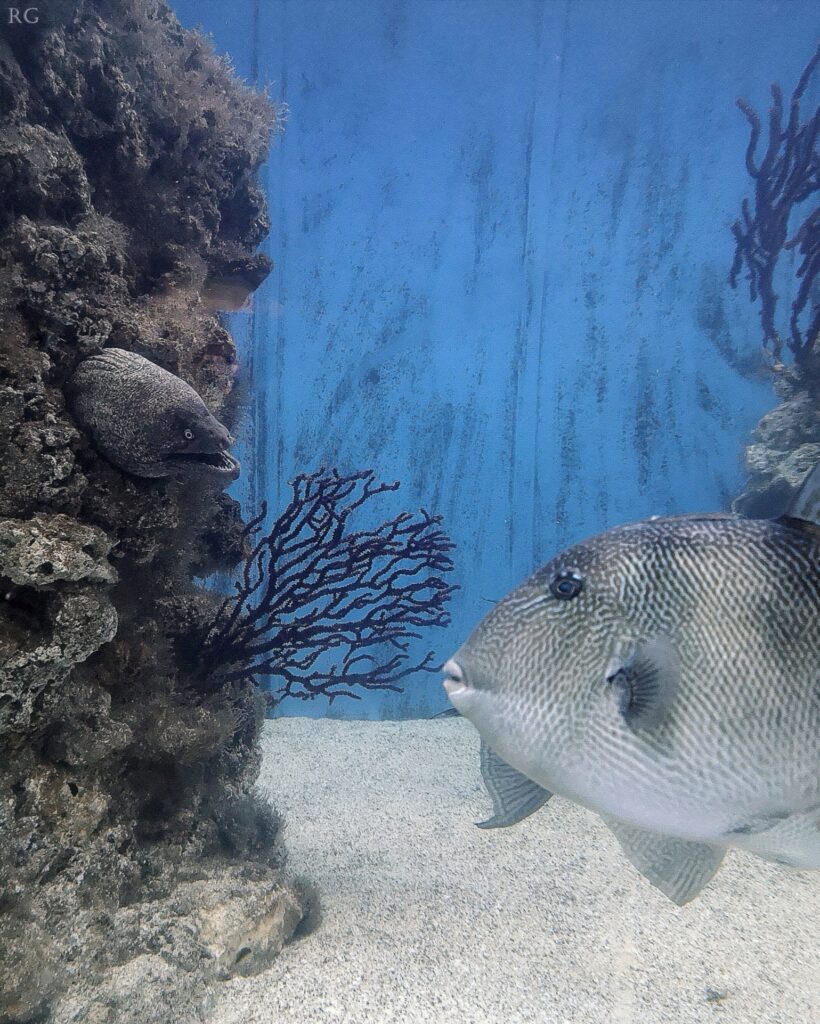
There I encountered an odd-looking fish – a grey triggerfish (Balistes capriscus), which I knew I had seen sometime before. It was summer, several years ago, and my father, a skillful fisherman, caught that same fish. It was the first time he saw it, but after this catch, that same summer he caught it 10-15 more times. People thought it was an invasive species – maybe it came with the ships.
The truth is, a grey triggerfish inhabits Western and Eastern Atlantic, and it is also an ordinary inhabitant of the Mediterranean.
It does not prefer cold water, and as the Adriatic is at the northernmost part of the Mediterranean, the sea tends to be colder there than in the rest of the Mediterranean.
A research based on satellite images of the Mediterranean showed that between 1985 and 2006, the biggest increase of mean sea surface temperatures in June was recorded in the Adriatic Sea, Ligurian Sea, Tyrrhenian Sea, and along the African coast – during the 22 years long research, the sea surface temperature in these areas has risen for 3,5°C.
If we take a look at a situation right above the surface, the temperature of the top 20 metres of the Adriatic Sea has increased by 1,8°C during the last 60 years. Also, the change in temperature is getting faster than before.
The species that were once present in the Southern Adriatic can now, due to the temperature rise, go further north.
Not very long ago, a grey triggerfish wouldn’t go further than the Southern Adriatic, but now we can find it much further north than that – last year it was recorded near the island of Krk.
It is odd to consciously witness the ongoing change in our environment. Some aspects of change are so rapid that even young people can easily remember and compare new reality with the past state. Nature evolves and adapts to the new conditions, animals change their behaviour, habitat, way of life.
Humans, on the other hand, resist change. We would rather ask of others to adapt to us, our needs, and our way of life. But what is stronger – an oak tree or a blade of grass? Even the strongest oak tree may eventually crack during a storm, but a seemingly fragile blade of grass survives unharmed.
Who knows, maybe soon we will be able to see with our own eyes some species that are today still out of our reach.
Literature
kostorog. Hrvatska enciklopedija, mrežno izdanje. Leksikografski zavod Miroslav Krleža, 2020.
Nykjaer, L. (2009): Mediterranean Sea surface warming 1985-2006. Climate Research 39: 11-17.
Turk, T. (2011): Pod površinom Mediterana. Školska knjiga, Zagreb.
https://www.fishbase.in/summary/7327
https://www.total-croatia-news.com/news/30696-adriatic-sea-warming-and-rising-at-an-alarming-rate