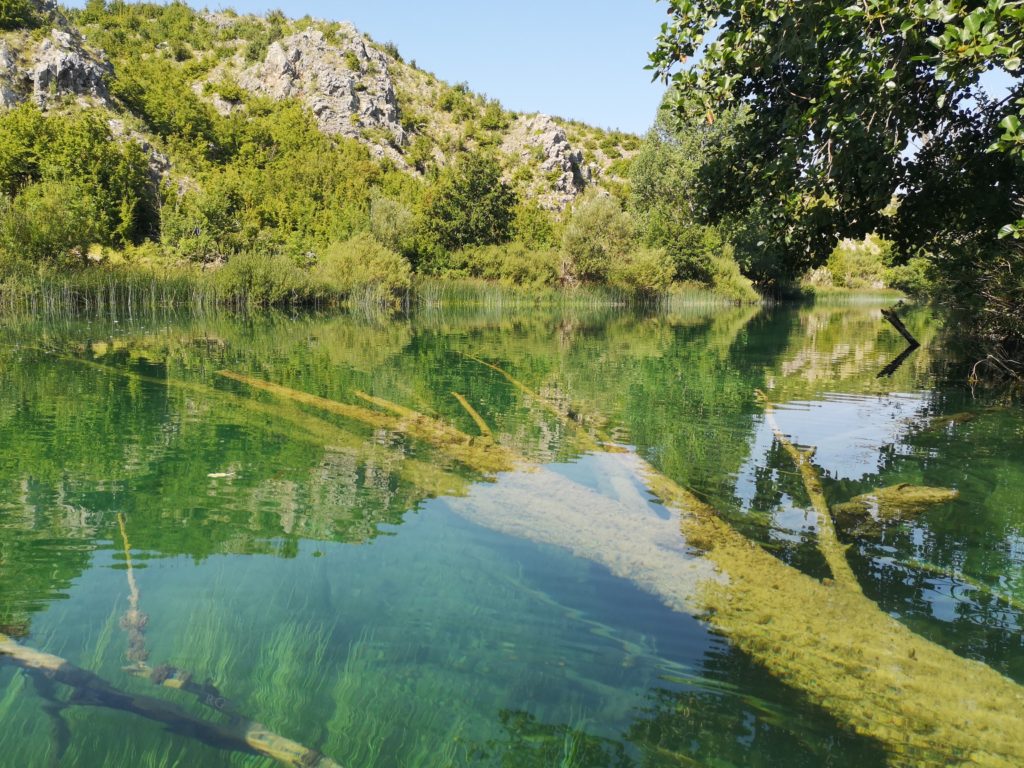
I truly cannot wait to come back to this magical place of peace and quiet. Here, nature is strong and powerful, water connects with the horizon and intertwines with greenery. I have never experienced this sort of strength – being used to the sea, which will always hold a special place in my heart, I witnessed a whole new kind of power coming from this fast, incredibly pure, cold, fresh water.
All the nature here modified and adapted to the present conditions, all the nature here was flourishing and blooming and shining, full of richness, full of strength that water has given to this place.
Today is the World day to combat desertification and drought. Some may say that international days are an artificial concept that neither brings change nor solves the problem, but why looking from that perspective? Why wouldn’t we use that possibility to introduce others with the actual problem? Why wouldn’t we accept the challenge and make this day different from other days in a year? If June 17 wasn’t proclaimed the World day to combat desertification and drought, my today’s topic would probably be different.
Desertification (Latin desertum: desert) is a permanent, usually irreversible reduction in the productivity of the land. On the other hand, drought is temporary land degradation in dry areas, where vegetation returns after rainfall.
Although summer droughts are harsh in some parts of Croatia, we still cannot fear encountering the real desertification.
Arid areas, called drylands, can be found on all continents except Antarctica. Most of them cover northern and southern Africa, western North America, Australia, the Middle East and Central Asia. They also exist in some parts of South America and Europe.
Although this term seems far from our reality – because typical sandy deserts seen in documentaries are way across the seas and oceans – the term does not refer to the literal expansion of deserts. It marks different processes that lead to permanent degradation of any arid or semiarid area, including grasslands and scrublands. It includes a decline in the quality of soil, vegetation, water resources or wildlife.
There are many possible causes that often work together and lead to soil degradation and desertification.
Some of the factors that can lead to desertification are deforestation, overgrazing of livestock, inappropriate irrigation and cultivation, climate change and global warming.
Rainfall patterns change rapidly around the world, droughts become longer and harsher, and contribute to desertification.
Climate change, largely influenced by humans, causes warmer and often drier seasons than before, which leads to more fires and poorer soil quality. In these conditions, it becomes difficult for soil to keep nutrients and maintain water, which decreases plant growth and leads to further desertification.
The term desertification also includes a weakened ability to farm the land. Drylands are home to around 2.7 billion people, and most of them live in developing countries. Many of them are poor and depend on farming. Desertification represents a serious problem for their well-being.
Like every environmental issue, desertification is better to be prevented than reversed. Attempts to recover desertified areas have shown to be very expensive and not very successful.
One of the methods is maintaining forests and other vegetation in order to protect soil from wind and water erosion. There are many methods for preventing and reversing desertification, but one is clear: if people were fully aware of the consequences that desertification brings, they would think twice before acting against nature.
Although Croatia still doesn’t have problems like this one, we are geographically not very far from them. Arid zones can be found in Spain, some parts of Greece, Turkey, etc. Our sea has already shown a significant increase in temperature. With time and with growing climate change, our land will go through some changes, too.
Maybe desertification is not our problem, but that doesn’t mean we have the right to not know anything about it – and it definitely doesn’t give us the right to act wrongly. To cut forests where and as we like it, to be unconscious in farming and cultivating, to act in a way that leads to further climate change.
Every problem in nature is like that, and I will probably write it again and again – we have to understand, learn, and then act. We have to teach others and raise awareness, so we could make a change.
It is very hard to say that one person can change something.
It is equally hard to say that one person, you, me, cannot change anything.
So, if both thoughts are equally hard to say and accept, I go with the first one. I have nothing to lose, and everything to get.
Literature
Millennium Ecosystem Assessment, 2005: Ecosystems and Human Well-being: Desertification Synthesis. World Resources Institute, Washington, DC.
https://www.britannica.com/science/desertification
https://earthobservatory.nasa.gov/features/Desertification/desertification2.php