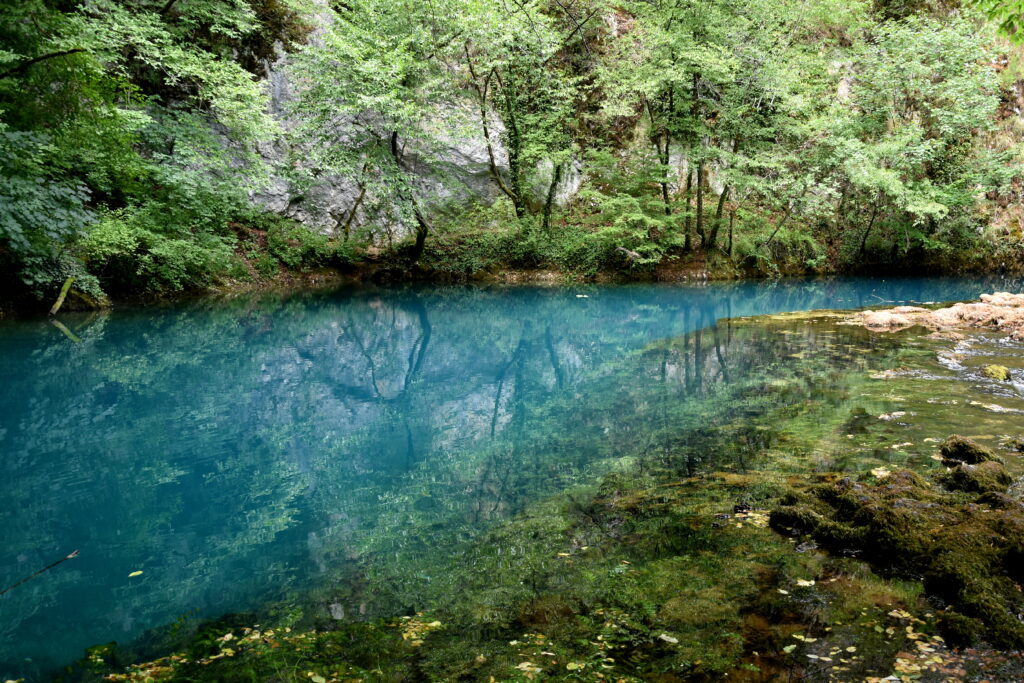
One of those places that seem too beautiful to be true is the source of the river Una. Colours that exist there, seems to me, show themselves in not so many other places.
The river Una begins its journey in Zadar County, close to the border with Bosnia and Herzegovina. The largest part of the river flows through the northwest part of Bosnia and Herzegovina, and at the end it joins the river Sava.
The source is shaped like a lake, where water comes from a great depth. That is why water is quite cold and has a constant temperature of around 8°C.
The source of the river Una was proclaimed a hydrological natural monument in 1968. It is one of the deepest karst springs in the world – in 2016. an Italian speleologist Luigi Casati dived to the depth of -248 metres, but the exact depth is still unknown.
The water is clear and drinkable, cold and refreshing. The number of visitors is not large, and I find it positive – this place still treasures its peace, its calm strength.
Although later in its flow, various activities such as rafting take their place, this initial part of the river is a hidden beauty.
Being there, feeling the cold breeze on a hot day, listening to the full power of cascades and waterfalls only a hundred metres downstream of the source, made me think.
In these situations, I always ask myself if I should write about those less famous places. When hidden gems become popular, their overall condition usually degrades.
But if you don’t experience real beauty, how will you develop a wish to care for it?
If you don’t experience nature, how will you ever develop a heartfelt desire to save it?
“No one will protect what they don’t care about;
and no one will care about what they have never experienced.”
Sir David Attenborough
One of my texts that was also inspired by the river Una:
Here is a text about another Croatian karst source – source of the river Kupa:
Literature
Casati, L., Garašić, M. (2016): Speleologia subacquea in Croazia – immersioni nelle sorgenti di Sinjac e Vrelo Une (Inquadramento geografico e geostrutturale del fiume Una). Speleologia, 37 (75), 39-42.