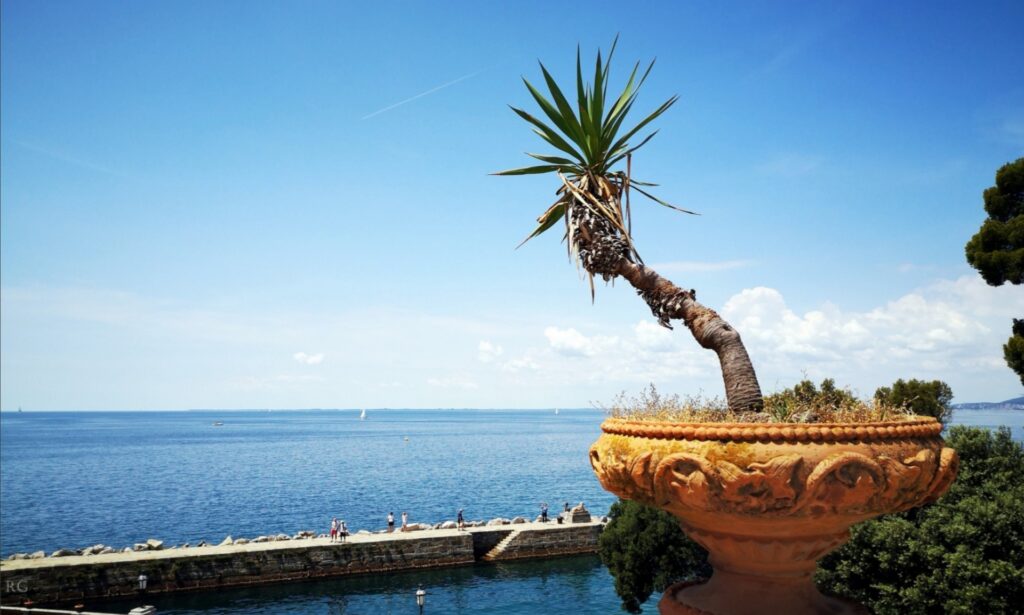
The same sea that I considered familiar, where my childhood summer days were spent; seeing it here from another country, standing on the unknown shore, surrounded by the other languages, I saw that the same sea was different, the underwater world here was not what I was used to.
Some marine species that here occur naturally, I saw them here for the first time, on my very first dive in the northern Adriatic. Some species that I have seen once in my life, long ago in the southern Adriatic, occur relatively often here.
It was like I met my sea a little bit better, as if it showed me a little bit more of its personality. It was a good day.
Castello di Miramare, the Miramare Castle, was built in 1856 by order of the archduke Maximilian of Habsburg. The Miramare park was a part of his private residence. The castle and the park are today included in the Miramare Biosphere Reserve, situated at the northernmost part of the Adriatic, in the Gulf of Trieste, Italy.
Generally, biosphere reserves have these three aims: conservation of biodiversity and cultural diversity, sustainable economic development, and research, monitoring, education and training.
Every biosphere reserve, including the Miramare Biosphere Reserve, has a core area, which is a zone with the highest protection, a buffer zone, where certain activities such as educational activities, research and monitoring are allowed, and a transition area, the least strict zone which stands between a biosphere reserve and a surrounding area.
The Miramare Biosphere Reserve is characterized by Zostera marina and Cymodocea nodosa meadows, with some species endemic for the Adriatic Sea, such as brown alga Fucus virsoides, and is also an important seasonal nursery area for different fish species in the northern Adriatic. Zostera marina and Cymodocea nodosa are two seagrass species, marine flowering plants that create a highly valuable habitat and hiding place for many different marine species. By losing them to eutrophication and mechanical destruction such as anchoring, the sea loses an important coastal zone which also produces oxygen, enhances water quality, and stabilizes sediment.
The Miramare Biosphere Reserve is a part of the Man and the Biosphere programme (MAB), UNESCO’s scientific programme that aims to establish a balance between biodiversity conservation and the development of local society.
Although boat transit is forbidden there, it is difficult to monitor it. The site is close to a touristic port, and being less than 8 km away from Trieste, a large seaport, the Miramare Biosphere Reserve is exposed to significant noise pollution.
Although it may not seem dangerous to us, the increasing noise pollution in coastal areas caused by human activities poorly affects marine species. According to research, noise pollution produced by humans has been rising within the last decades with increased urbanization in coastal areas and increased boat traffic. The rising trend is visible not only in coastal areas but in the open ocean too.
But, besides causing stress, why would noise negatively affect marine animals?
There are certain fish species that have well developed auditory sensitivity and rely on surrounding sound signals.
In the Miramare Biosphere Reserve, there are three fish species that significantly rely on sound: Chromis chromis, Sciaena umbra, and Gobius cruentatus.
According to research, noise in the marine environment causes stress, changes detection of a predator or prey, and thus increases the risk of mortality. It also interferes with orientation and sound communication, especially in the reproductive period.
For example, it is shown that boat noise recorded within the Miramare Biosphere Reserve might reduce the fish hearing ability and disguise important signals of other individuals of the same fish species.
The detection distance of the sound in conditions without boat noise is at least 10 m. Boat noise completely masks the signal of other fish individuals, even at less than one meter.
Marine protected areas like this one are extremely important for valuable marine communities, but more than that, it is crucial to maintain certain standards in monitoring and sustaining the right conditions by making community to follow the rules.
Protected areas are protected for a reason. We have to guard them and try to keep negative actions, like boat traffic in this instance, out of reach.
This is an interesting example of how our behaviour can seem unimportant, but can change lives around us, even the ones we have never noticed.
So, if we have that much influence, why wouldn’t our acts change lives around us to the better?
Codarin A. , Wysocki L. E., Ladich F., Picciulin M. (2009): Effects of ambient and boat noise on hearing and communication in three fish species living in a marine protected area (Miramare, Italy). Marine Pollution Bulletin 58: 1880–1887
Codarin A., Picciulin M., Sebastianutto L., Calcagno G., Spoto M. , Ferrero E. A. (2012): Nocturnal acoustic activity in the shallow waters of WWF-Miramare Natural Marine Reserve (Trieste, Italy). Advances in Experimental Medicine and Biology 730:161-164
Farina An., Farina Ad., Armelloni E. , Sebastianutto L., Franzosini C., Picciulin M. (2012): First description of the sound pressure and particle velocity components of the ambient noise and boat noise recorded at the WWF- Miramare Natural Marine Reserve (Trieste, Italy). Advances in Experimental Medicine and Biology 730:485-8