These days, more than ever, we enjoy nature and search for the opportunity to go out, breathe the fresh air and rest our eyes enjoying million calming shades of green. Fortunately, we don’t have to go far from our homes to enjoy nature.
Green spaces in urban areas have positive effects on different aspects. Usually, the first positive side of green spaces that comes to our mind is that it gives us the opportunity to enjoy nature without leaving the city, and with that, it raises the quality of our lives. Just imagine your city without any greenery around you, even without those tiny grassy circles around the trees on the street – or even without those lonely trees. The picnics, barbecues, and walks in the parks would be impossible. City life would be painted in gray, even in sunshine.
The biological aspect brings biodiversity into focus, with urban greenery offering space for maintaining urban biodiversity. Besides that, urban green spaces help in the reduction of noise, air pollution, heat waves, and flooding. You have probably experienced that feeling of instant freshness in the air when entering any bigger park or urban forest. Those green areas of our towns bring us much more than a place to spend our leisure time. They unburden our cities of exhaust gases, dust, extreme temperatures or rainfall.
On the other hand, in some areas, especially those in dry regions, the maintenance of urban green areas brings some questions regarding water consumption. In arid parts water is considered scarce and valuable, and because of that the question emerges which of those two is more important: green spaces or water saving.
One interesting research in Australia estimated that more than 11.000 m3 of water was needed to maintain one hectare of urban greenery annually. Around 60% of all spent water was the water extracted from water bodies, a very valuable source of water in arid areas.
And while some estimate that at least 9 m2 of green space per individual is needed, it is interesting to see how much greenery some cities across the globe have: Oslo 68%; Helsinki, Stockholm and Hong Kong 40%; Rome 39%; Paris 9,5%; Istanbul 2,2%.
No matter how much greenery your town has to offer, you can try to create it on your own.
How can you improve your own green space, and make an eco-friendly version of your terrace, balcony, or garden?
- Grow native plants. Great thing is that native plants are often easy to maintain, as they are well adapted to the present climate conditions. But there are some positive ecological sides, too: growing native plants helps to preserve our indigenous species and at the same time prevents the spread of non-native – and possibly invasive – plant species.
- In battling pests, find a weapon that does not include chemicals. Chemicals can impair soil quality or your plants’ health. Milk, baking soda, vinegar, essential oils, alcohol, and other ingredients that we can find in our homes can help against certain pests and diseases.
- Make your own compost. That way you reduce your waste, you save money, and you have a completely natural compost from controlled sources. Ecologically observing, it is more important than some might think. With its unique properties, compost is a valuable habitat for microorganisms and invertebrates, some of which later become food for, for example, birds.
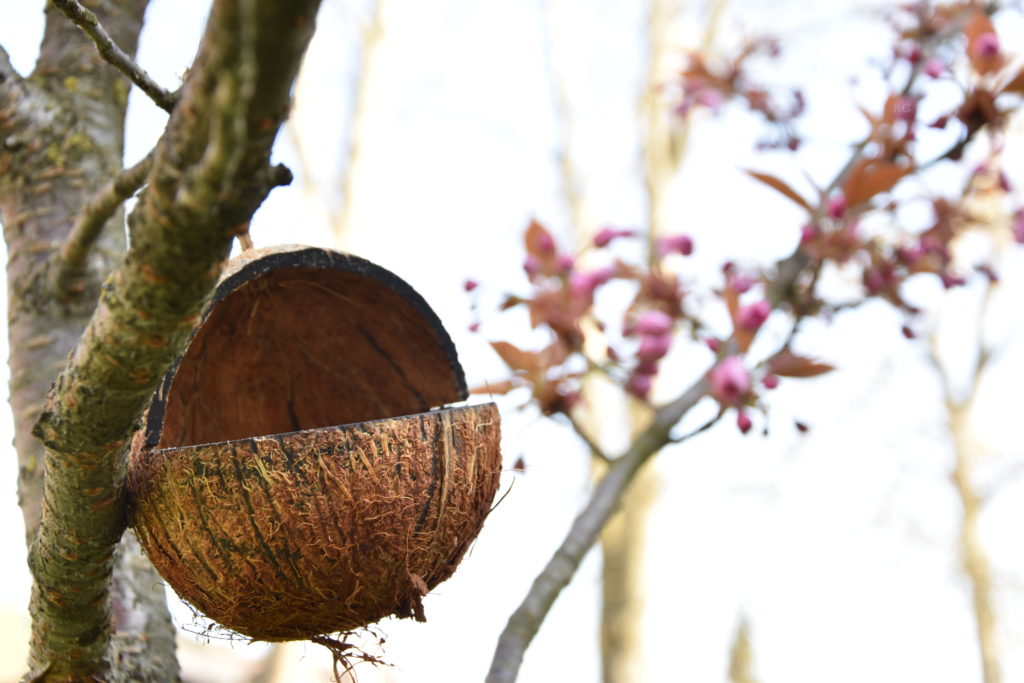
- To make your private green space even more suitable for wildlife, you can always make a birdhouse or shelters for some other wild species, depending on the possibilities of your space.
- Make a room for growing your own food. If you don’t have much space, you can choose growing vegetables that are easily grown in flowerpots. If you have a larger terrace or a garden, there are many possibilities for making your own food. Not only it is 100% controlled, more eco-friendly, and cheaper, but it also tastes better – if nothing else, because you know you have grown it all by yourself!
- When planting flowering plants, choose various pollen-rich flowers. Plant different species that bloom in a different time of the year. That way you will help bees and other diligent pollinators in their job. Bees will be grateful to you 🙂
Nouri H., Chavoshi Borujeni S., Hoekstra A. Y. (2019): The blue water footprint of urban green spaces: An example for Adelaide, Australia. Landscape and Urban Planning 190 103613.
Urban green spaces: a brief for action. World Health Organization, Regional Office for Europe, 2017.
http://www.worldcitiescultureforum.com/data/of-public-green-space-parks-and-gardens